Features & Technology
Six layers. One scan. Zero blind spots.
SenseRadar turns the radios and sensors already in your phone into a professional counter-surveillance kit. Here is what each layer does — and how.
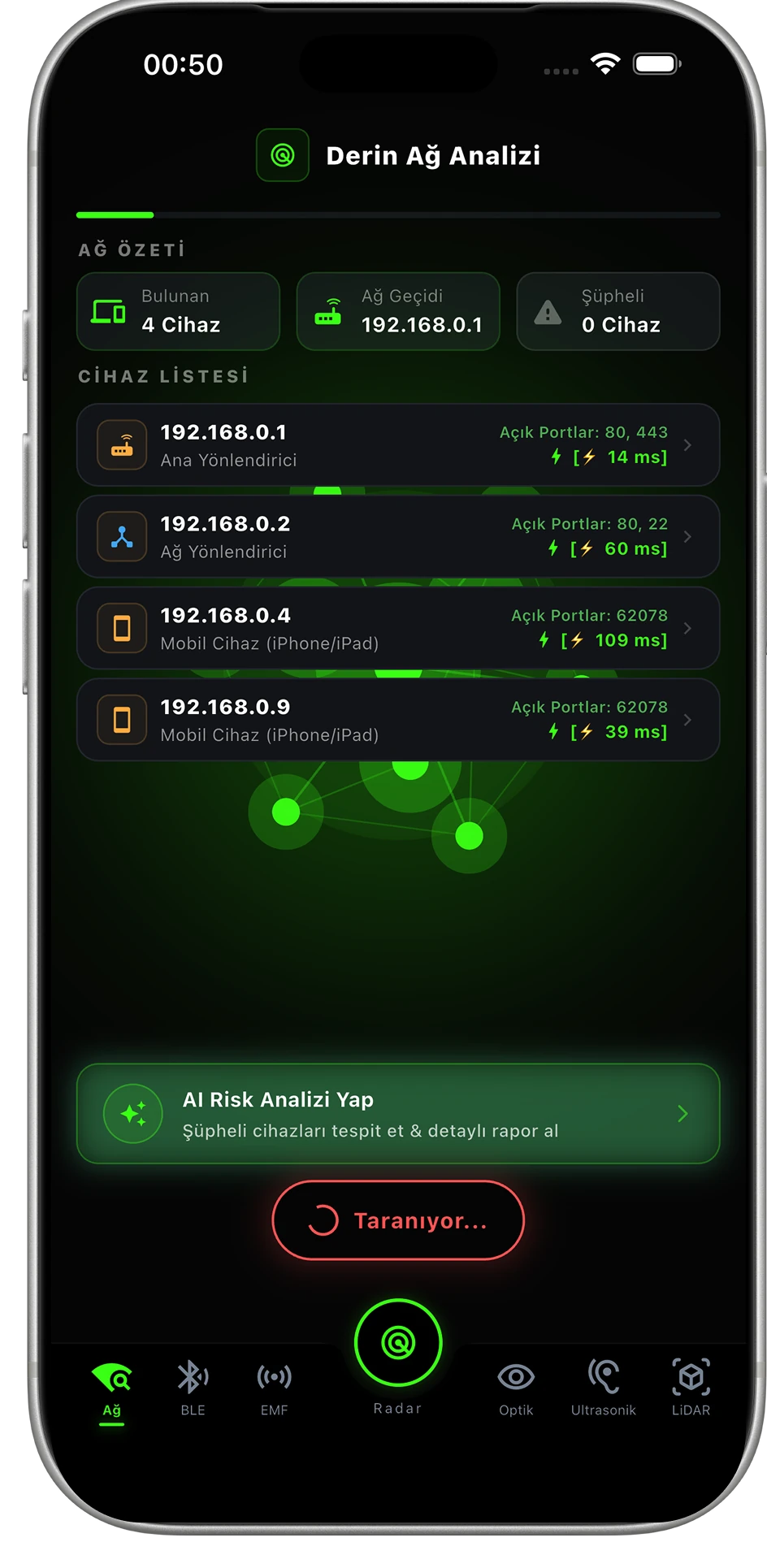
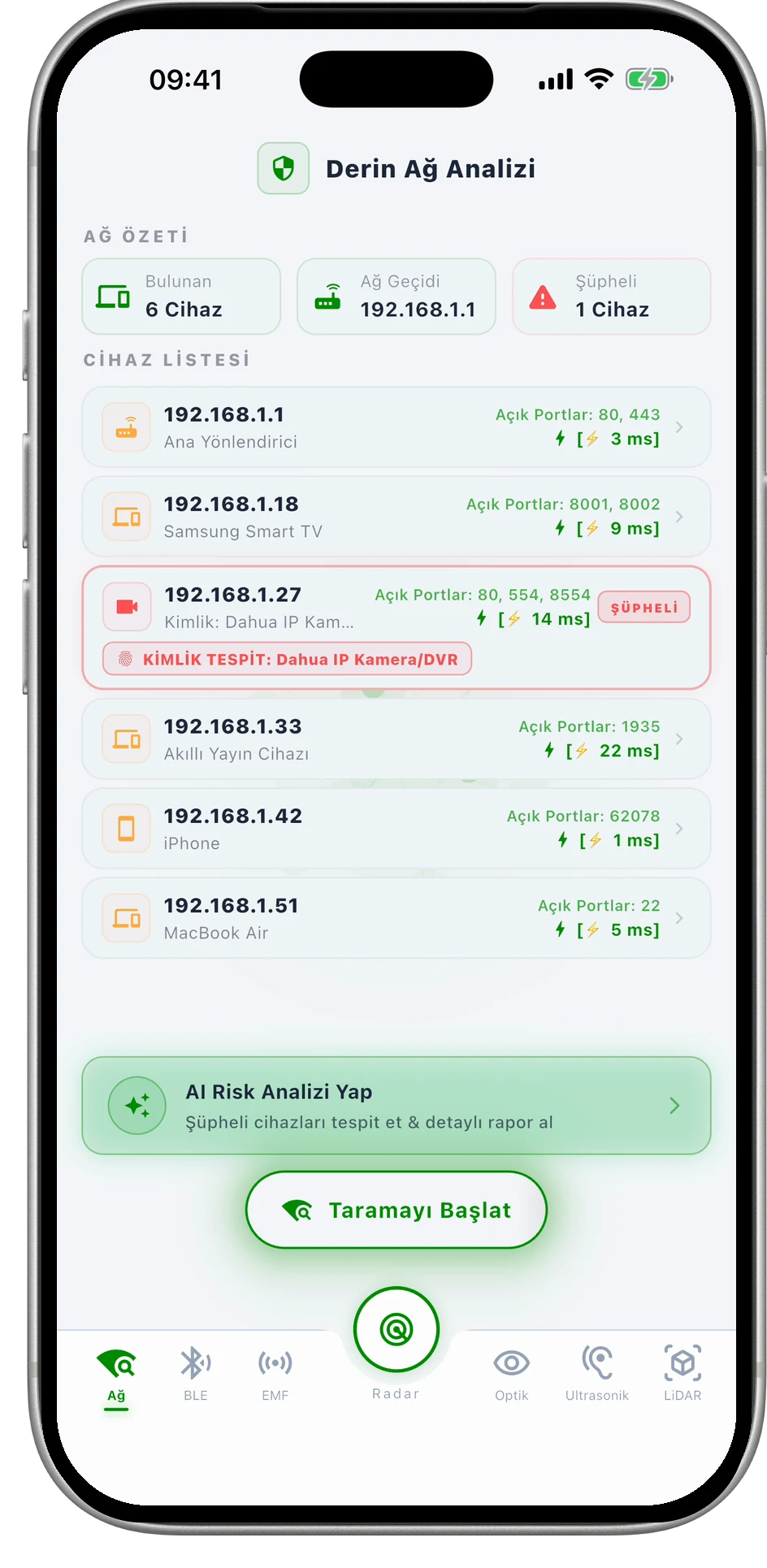
WiFi Scan — Deep Network Analysis
Most consumer spy cameras stream over the local WiFi network. SenseRadar maps every device on the network you are connected to, resolves manufacturers, checks open ports and highlights hardware that behaves like a camera.
- Discovers all devices on the network with response-time profiling
- Flags suspicious open ports used by streaming cameras
- One-tap AI risk analysis with a detailed device report
Keep in mind: This layer only sees devices on the network you are connected to. A camera with its own SIM card, or one that records without streaming, will not appear here — that is where EMF and the optical scan take over.
Related guide Airbnb Hidden Camera Check: Your Rights
BLE Scan — Precision Detector Mode
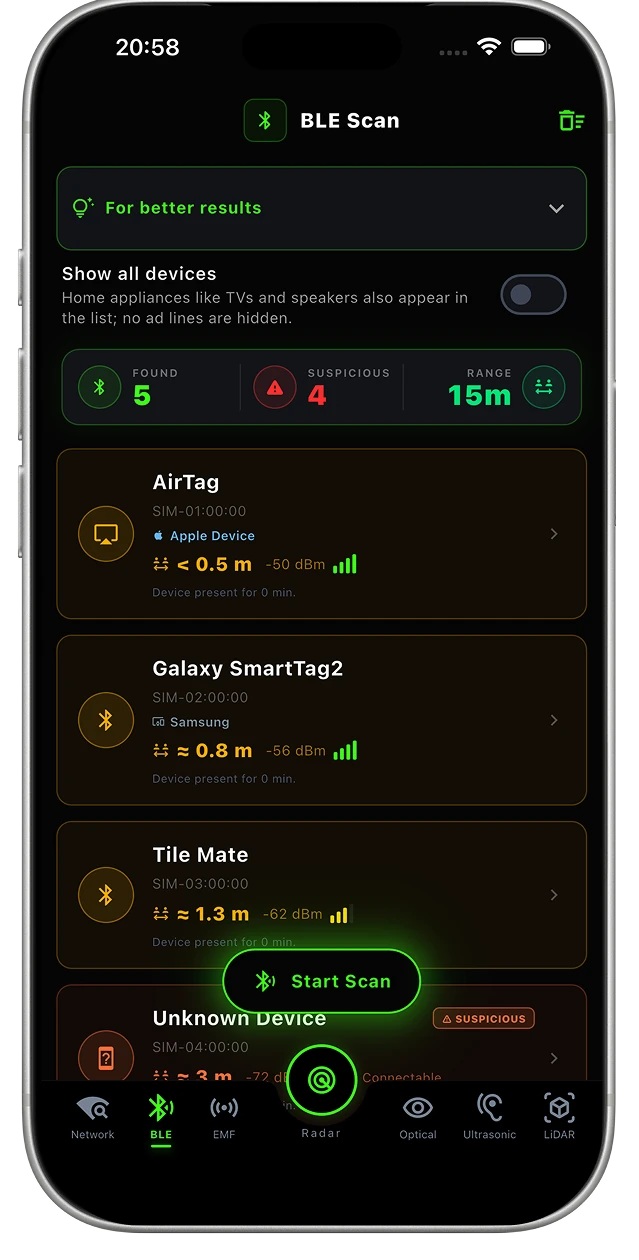
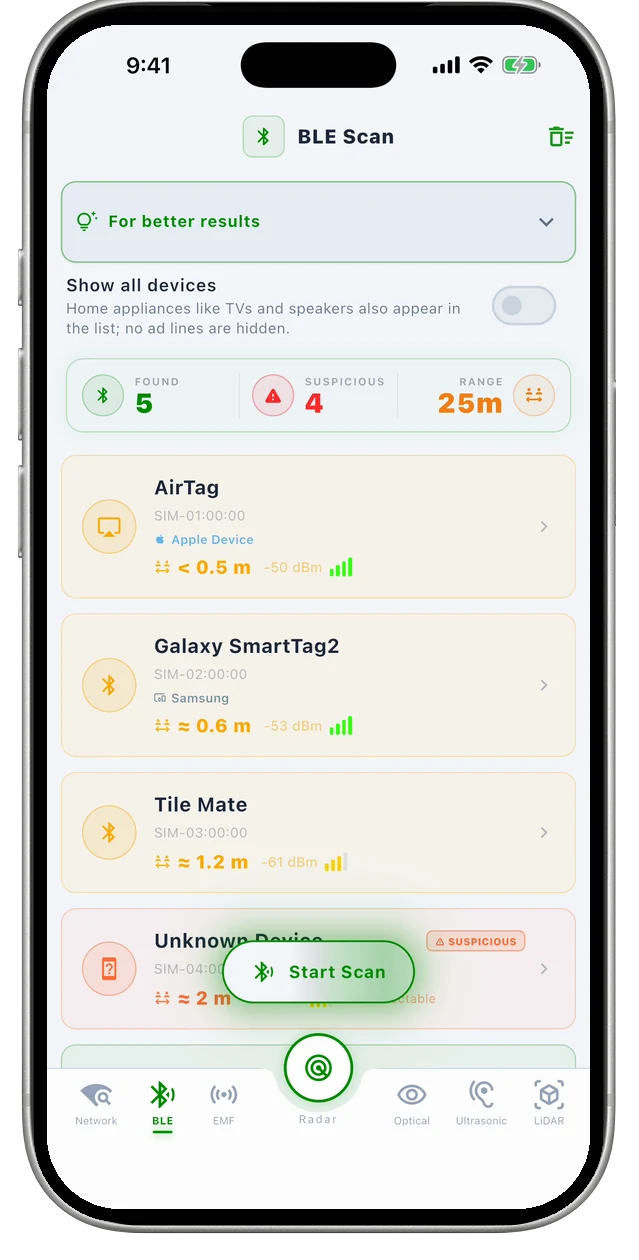
AirTags and other Bluetooth trackers announce themselves with radio signals. SenseRadar catches anonymous BLE devices around you, measures their signal strength in real time and tells you whether one is moving with you.
- Live RSSI signal strength with estimated distance
- "Approaching" alerts as you close in on the source
- Range Mode: adjustable range sensitivity from 5 to 25 meters
- First-seen timestamps to spot devices that follow you
Keep in mind: Some trackers can hide from third-party scanners while their owner is nearby. If you are still suspicious, sweep your belongings with the EMF layer at close range: a tracker's battery and speaker magnet cause a clear spike.
Related guide How to Tell If You're Tracked: AirTag Detection
EMF Measurement — Magnetic Anomalies
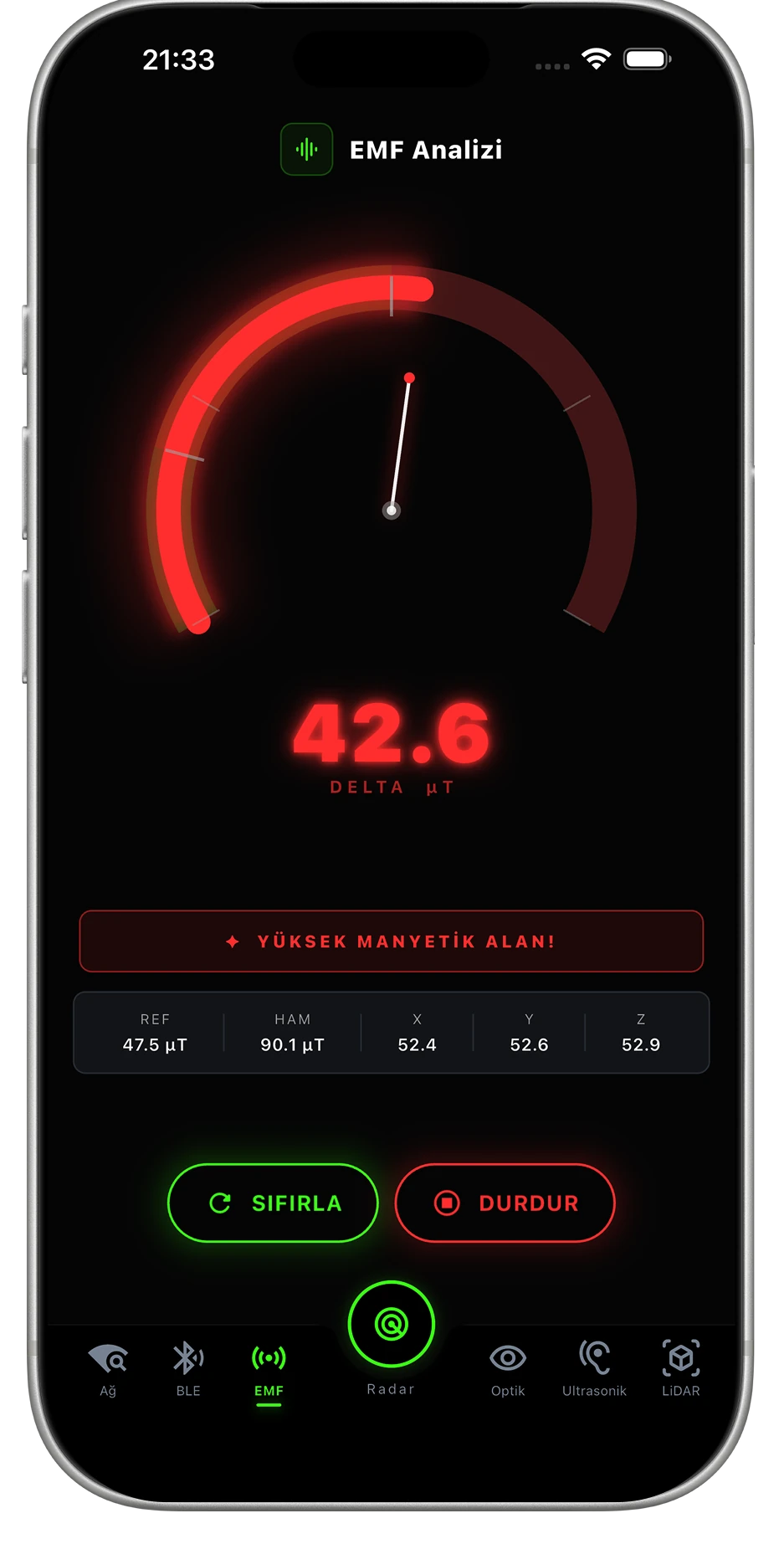
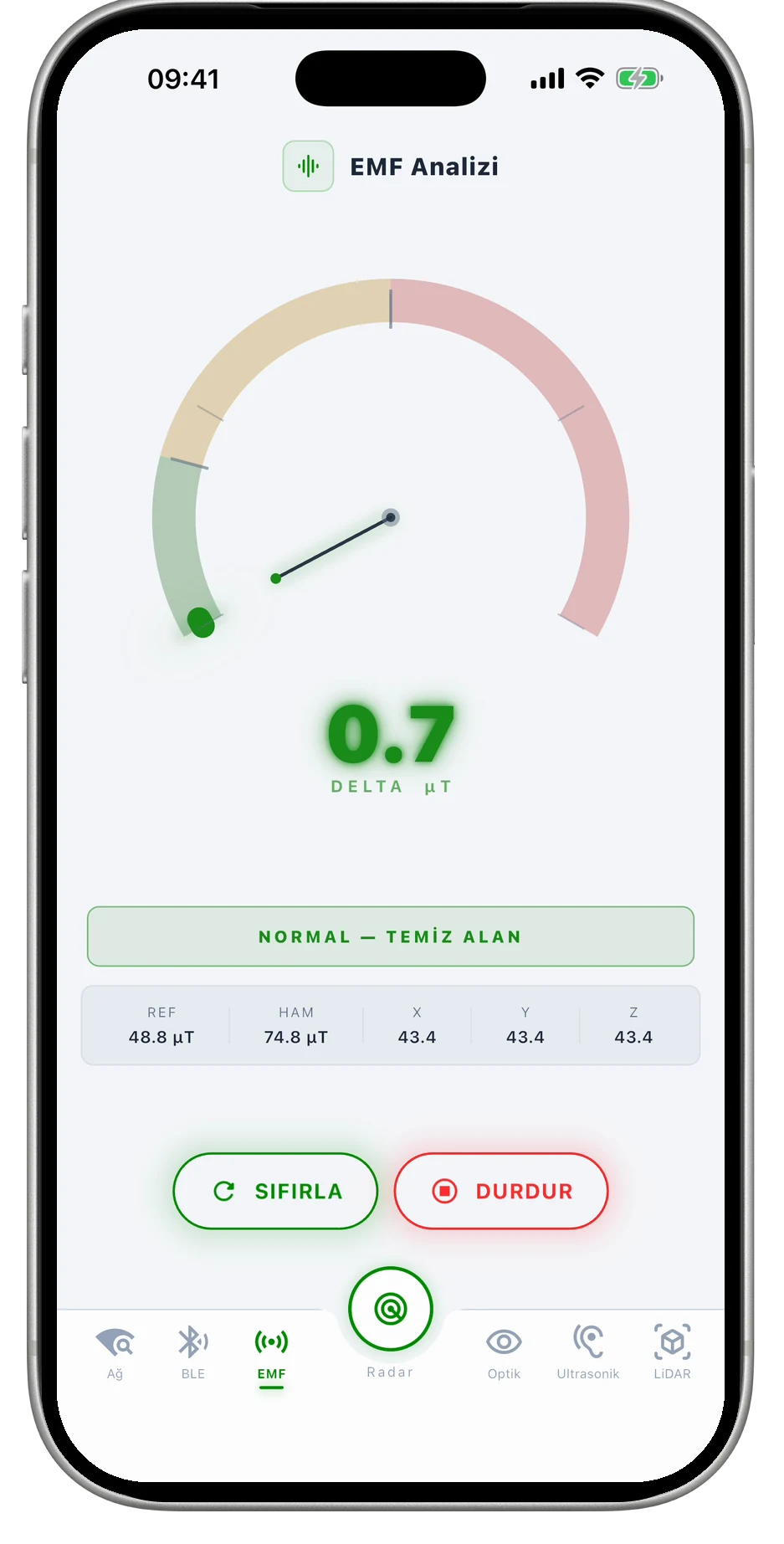
Powered electronics distort the magnetic field around them. Using the magnetometer, SenseRadar measures deviations from the ambient baseline and warns you when a wall, mirror or object hides active circuitry.
- Delta measurement against a calibrated reference
- Live X / Y / Z axis readings in microtesla
- High magnetic field alerts with visual gauge
Keep in mind: Readings rise naturally near known appliances such as TVs, microwave ovens and speakers. Measuring away from them keeps false alarms down.
Related guide How to Find Hidden Cameras in a Hotel Room
AI Optical Scan — Lens Detection
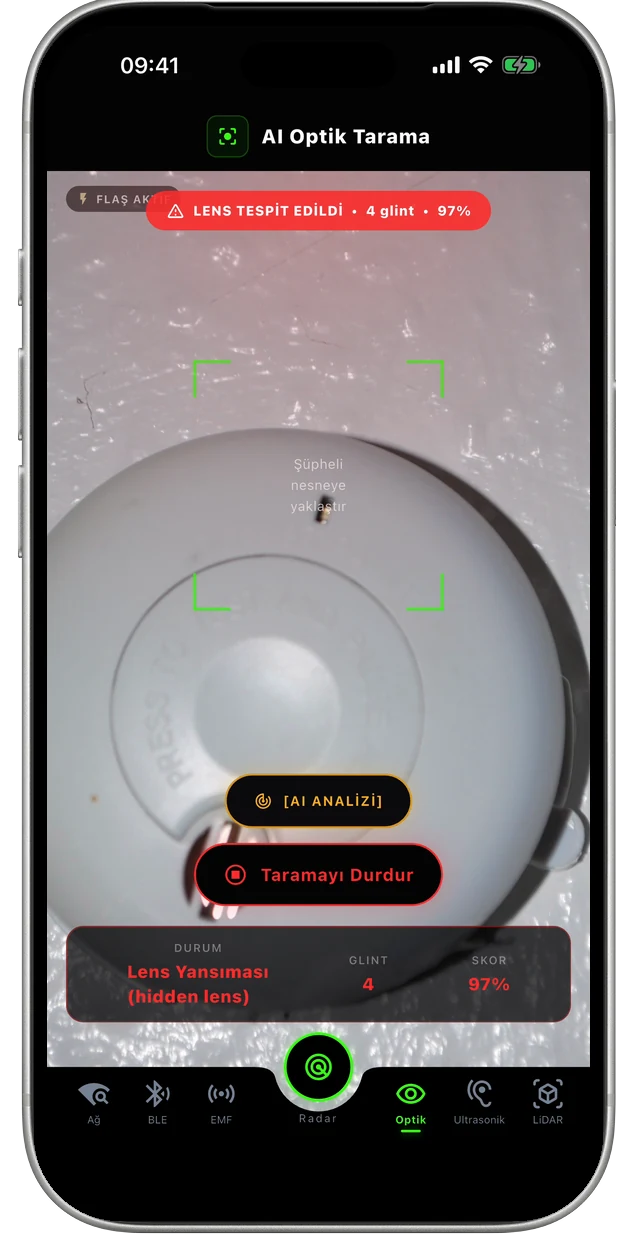
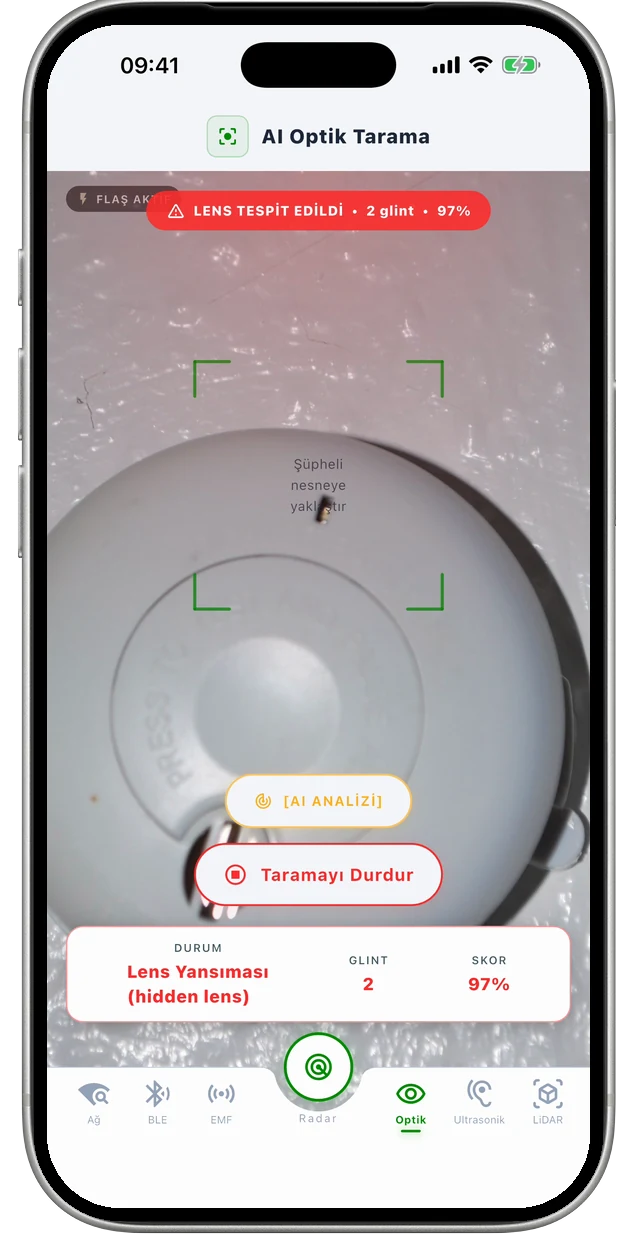
Every camera needs a lens, and every lens reflects light. Run an optical scan on smoke detectors, power outlets, clock radios and other suspect devices — the on-device AI model, trained specifically for lens detection, catches the telltale glint of hidden optics.
- Real-time lens reflection detection through your camera
- On-device detection, plus optional AI Sniper cloud analysis on demand
- Guided sweep mode for beds, bathrooms and dressing areas
Keep in mind: A lens glint stands out in the dark. Turn the lights off or dim them, move the phone slowly and keep the suspect object sharp inside the on-screen frame.
Related guide Where Are Hidden Cameras Hidden? 12 Spots
Ultrasonic Detection — Acoustic Analysis
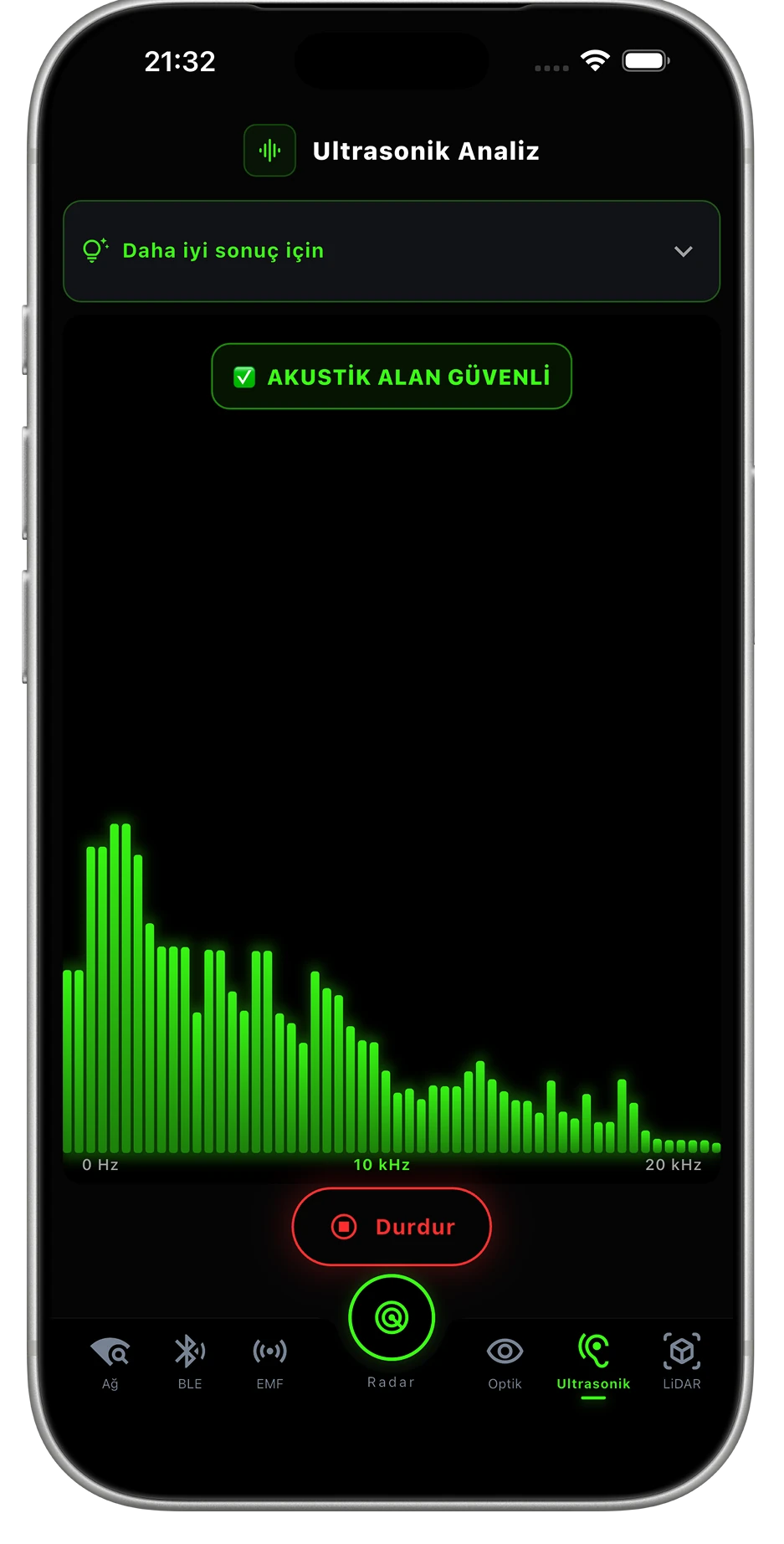
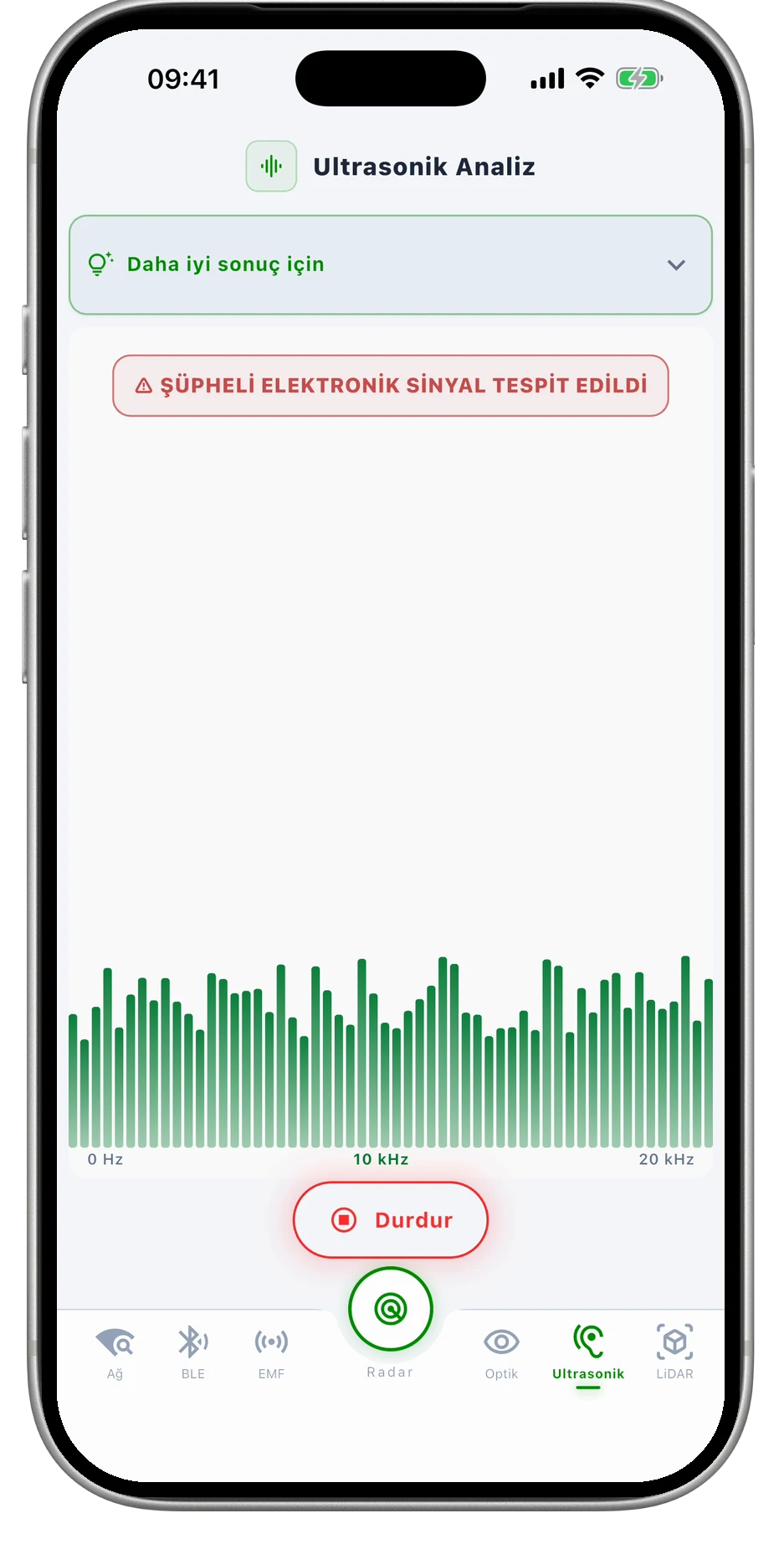
Some recording and tracking hardware emits ultrasonic noise far above human hearing. SenseRadar runs a live spectrum analysis from 0 to 20+ kHz and marks the acoustic field as safe or suspicious.
- Full-spectrum live audio visualization
- Detects high-frequency emissions of active electronics
- Clear safe / suspicious verdict for the acoustic field
Keep in mind: Stand still during the measurement and close doors and windows. Pets or some Bluetooth speakers may react to the test signal; that is normal.
Related guide How to Find a Listening Device in Your Home
LiDAR Scan — Structural Anomalies
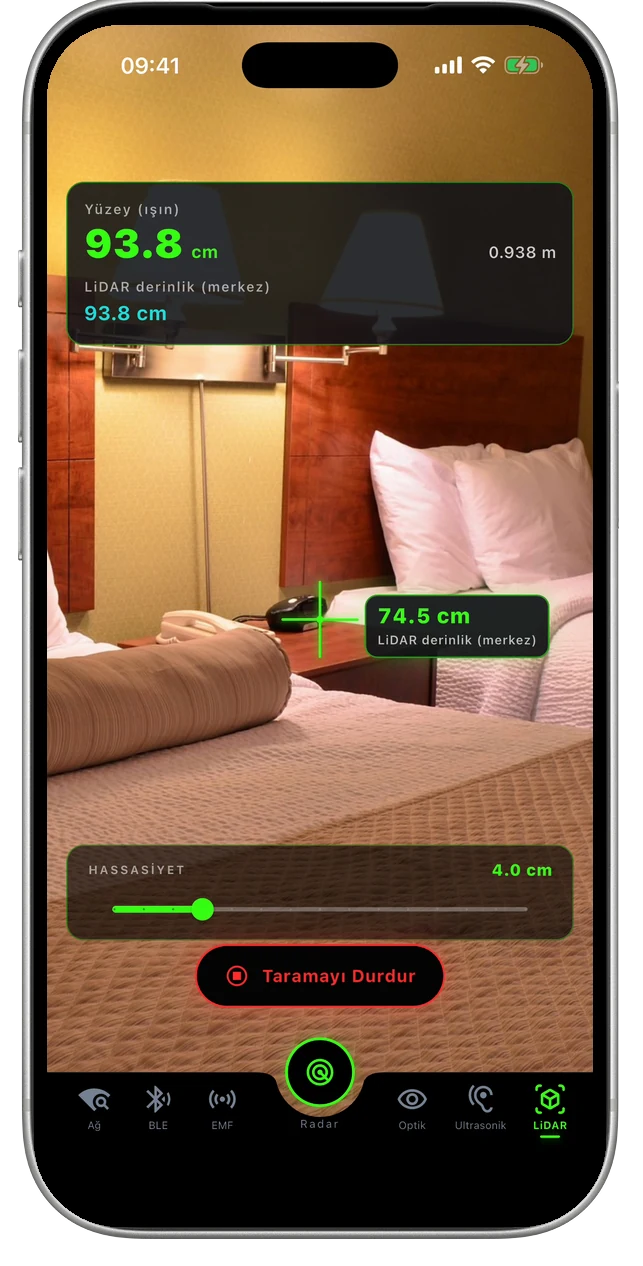
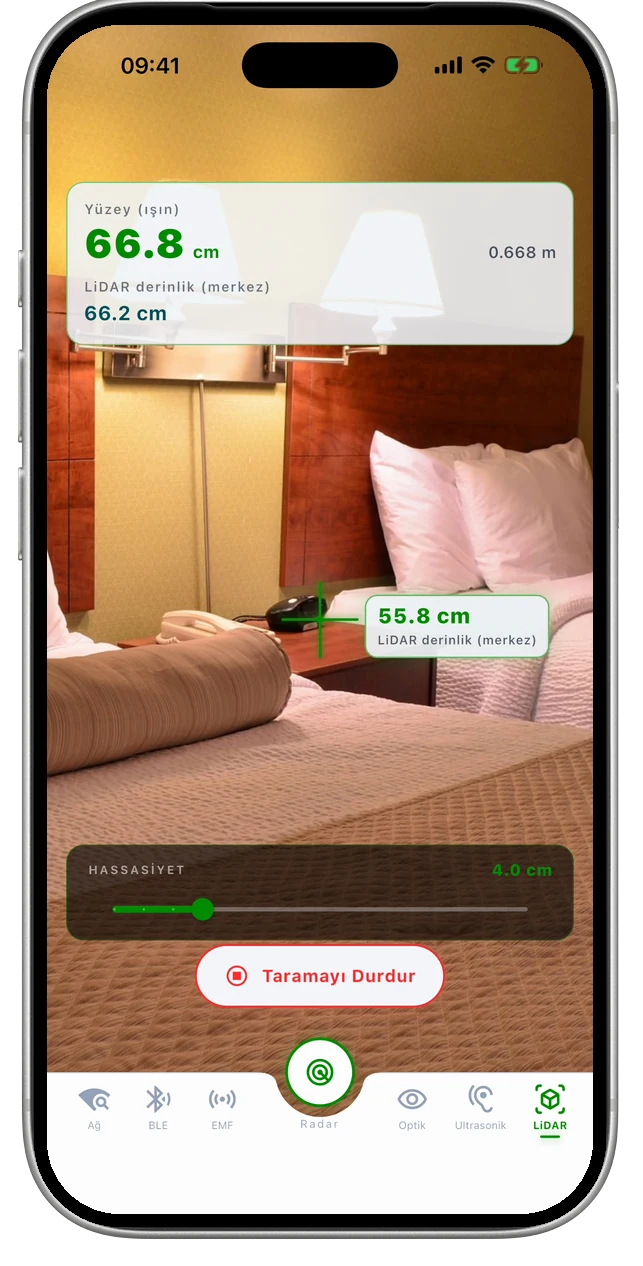
On supported phones, depth scanning (the LiDAR sensor on iPhone, ARCore Depth on Android) measures surfaces with high precision. SenseRadar compares depth readings to detect cavities and surface layers where a device could be embedded.
- Millimeter-level surface distance measurement
- Detects hidden gaps behind panels and mirrors
- Adjustable sensitivity from 1 to 10 cm
Keep in mind: Requires an iPhone with a LiDAR sensor (iPhone 12 Pro and later Pro / Pro Max models) or an Android phone that supports ARCore Depth. Hold the phone 30–50 cm from the surface and make sure it is well lit.
Related guide Hidden Cameras in Beauty Salons
Why do the layers work together?
No single method catches every device. A network-connected IP camera shows up in the WiFi scan, but a camera with its own cellular connection does not. Its lens, however, leaves a trace in the optical scan, and the current it draws shows up in the EMF reading. An AirTag never appears on WiFi, yet its Bluetooth broadcast gives it away to the BLE scan.
That is why SenseRadar dedicates each layer to a different kind of trace: radio broadcasts, electromagnetic fields, ultrasonic sound, lens reflections and surface depth. A device that draws power and sends data leaves at least one of these traces, and six independent layers raise the chance that one catches what another misses. Still, no method is 100% certain: a recorder that is fully switched off and silent can only be found by a physical search.
In practice the order is simple: first list the broadcasting devices around you with WiFi and BLE, then check suspicious spots — smoke detectors, sockets, clocks, mirrors — one by one with EMF and the optical scan. The ultrasonic and LiDAR layers are the last step, for telling whether something sits behind a surface that looks perfectly normal.
