Key takeaways
- No method covers every case on its own: an RF detector only finds devices that transmit, and a lens finder only finds lenses in its line of sight.
- A phone app checks several traces at once (network, Bluetooth, lens glint, magnetic field) with no extra gear, but no phone can listen across as wide a frequency range as a dedicated RF receiver.
- The most practical setup for travel: a layered scan with your phone, then a hands-on check of whatever it flags. For serious suspicion (workplace, legal case) a professional sweep is needed.
There is no single right tool for finding hidden cameras: each method catches a different trace a device leaves and misses another. This guide compares the five most common methods on the same criteria: what they find, what they miss, what they cost and who they suit.
Quick answer: what does each method find?
- Phone app — Finds: devices on the same WiFi network, Bluetooth broadcasts, lens glints in the dark, magnetic fields at close range. Misses: devices on another network or a cellular link with Bluetooth off (lens and EMF checks partly make up for this). Cost: you already own the phone.
- RF detector — Finds: wireless cameras streaming live, GSM/4G listening devices and GPS trackers while they transmit. Misses: devices that record to a card and never transmit; false alarms are common in WiFi-heavy hotels. Cost: usually $20–200.
- Lens finder (red-LED viewer) — Finds: a camera lens in its line of sight, even when the camera is off. Misses: lenses behind a wall or object, microphones, trackers. Cost: usually $15–50.
- Physical search — Finds: anything you look at carefully; free. Misses: anywhere you don't look; slow, and you need to know what to look for.
- Professional sweep (TSCM) — Finds: the widest range, including switched-off devices, using spectrum analysers, thermal cameras and non-linear junction detectors. Misses: very little in practice, but it is expensive and not realistic for a hotel room.
Phone apps: strengths and limits
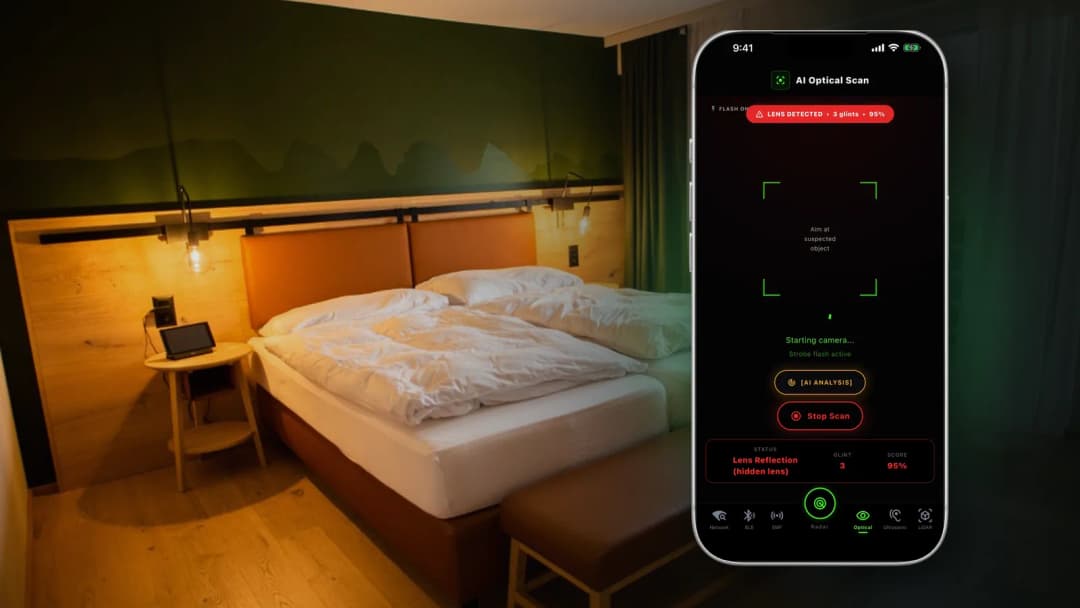
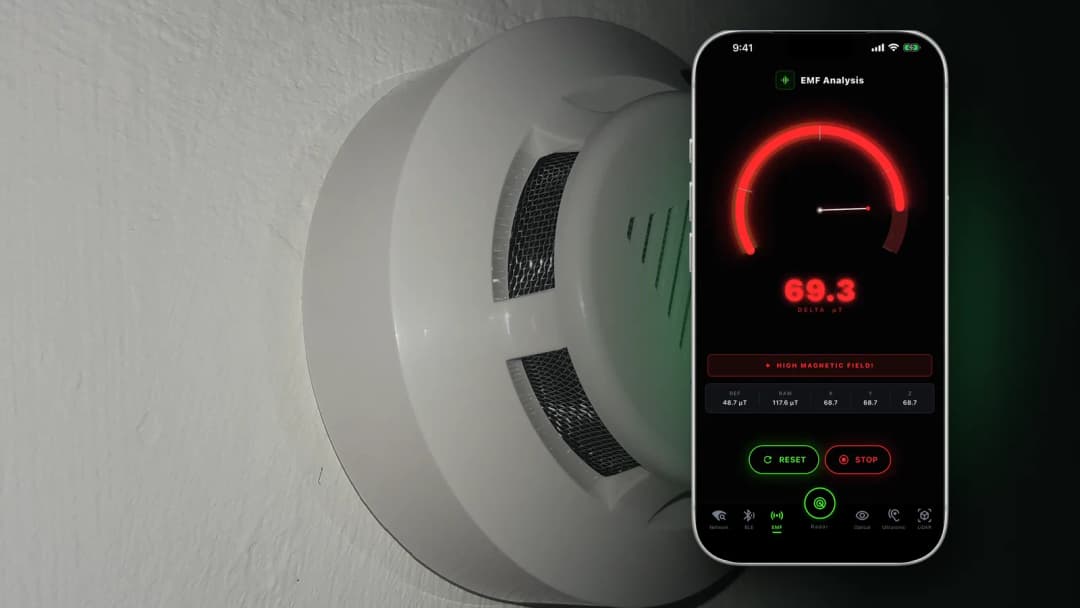
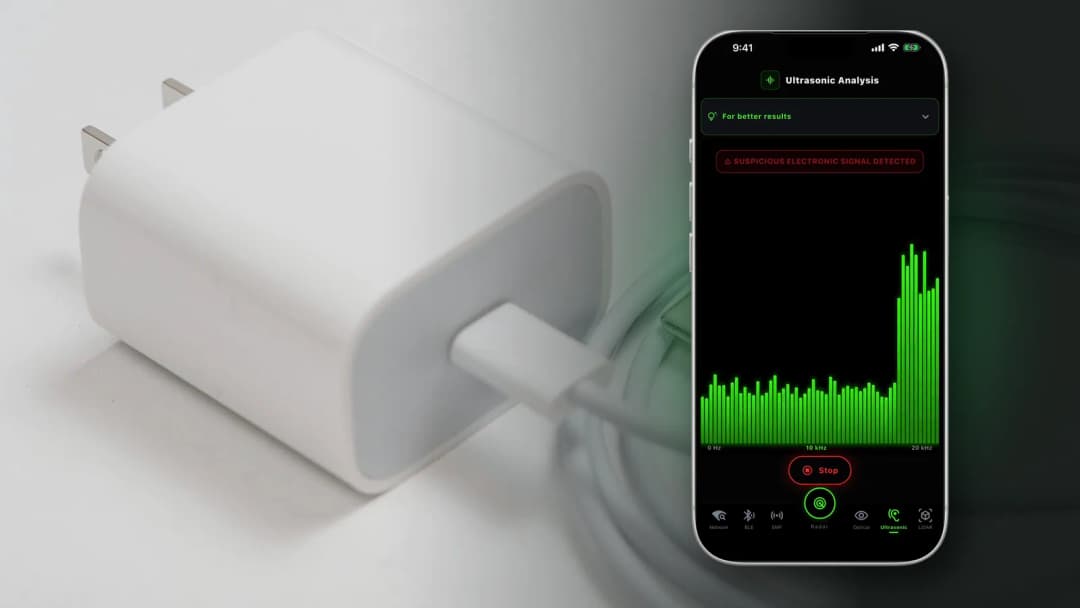
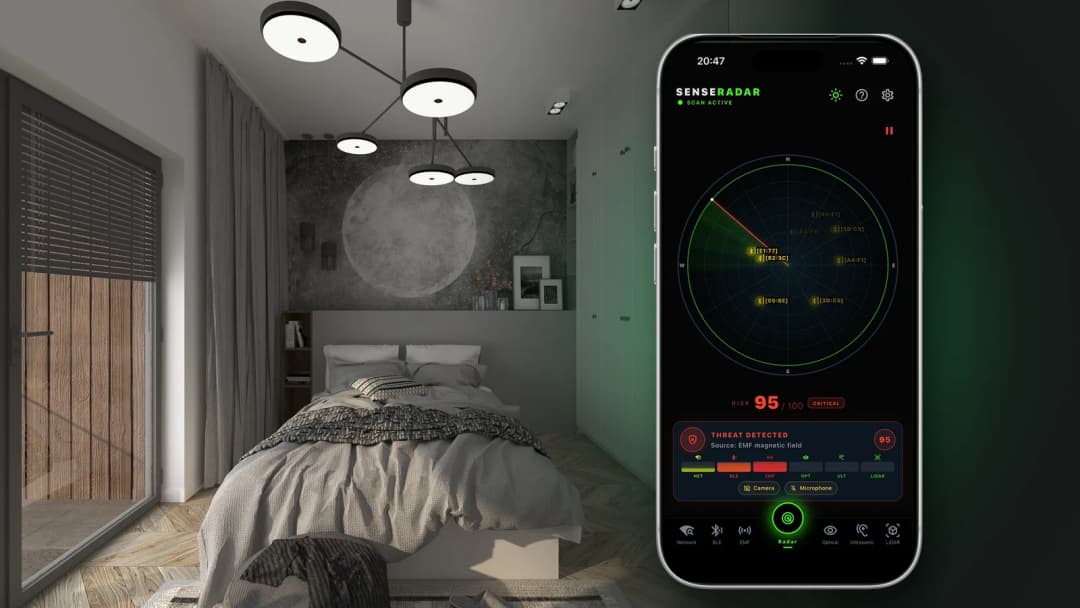
Without buying any hardware, a phone can check four different traces: unfamiliar cameras on your network with a WiFi scan, nearby trackers with a Bluetooth scan, lens glints with the camera, and the magnetic field around electronic circuits with the magnetometer. SenseRadar adds ultrasonic analysis and depth scanning to combine six layers in one app.
The limits are just as clear: a WiFi scan only sees devices on the same network as you, so a camera on its own hidden network or a cellular link stays invisible. The magnetometer's range is a few centimetres, so an EMF scan means holding the phone close to the object. Phones cannot listen across the wide frequency range an RF detector covers. Every flag in an app is therefore a lead to verify by hand.
RF detectors: when do they help?
An RF detector measures radio transmissions in the air; a camera streaming live video or a listening device sending audio over a cellular link raises the reading the moment it transmits. For devices that transmit, it is a strong method.
Its weakness is devices that don't transmit: a camera recording to a memory card produces no signal at all. A modern hotel room is also full of constant transmitters — the router, the smart TV, your own phone — and cheap detectors raise frequent false alarms in that noise. The right technique is to switch off known transmitters and move from object to object, watching whether the signal rises.
Lens finders and physical search
A lens finder lights the room with red LEDs while you look through a viewer; a camera lens reflects the light back and shows up as a small, bright dot. It works even when the camera is off, but only from angles where the lens faces you. A phone's flashlight and camera can be used the same way; SenseRadar's optical scan flags that reflection with AI.
Physical search is the last step of every method: examining a flagged object, looking behind it, following its cable. On its own it is slow; once other methods narrow down where to look, it becomes fast and conclusive.
Which method for which situation?
- Hotels and rentals: a layered phone scan, then a lens and hands-on check of flagged objects. No extra gear to carry.
- Frequent travellers: a pocket-size lens finder alongside the phone speeds up lens checks in a dark room.
- Suspected tracking in a car: a Bluetooth scan with the phone (AirTags and similar) plus a hands-on check under the car, the bumpers and the OBD port; an RF detector helps with cellular trackers.
- Office, meeting room or legal case: a professional TSCM sweep. If a find may be evidence, don't touch the device and contact the authorities.
Frequently asked questions
Do hidden camera detector apps actually work?
With the right expectations, yes. An app can show devices on the network, on Bluetooth and in its line of sight, as well as strong magnetic fields, but on its own it cannot guarantee finding a device that neither transmits nor is visible. The best results come from checking what the app flags by hand. No method offers a 100% guarantee.
Should I buy an RF detector or use an app?
For most travellers the phone is enough to start with: it costs nothing extra and combines several methods. If you specifically suspect devices that stream live or cellular listening devices, a good RF detector is a useful addition.
Which method finds a camera that is switched off?
A switched-off camera neither transmits nor produces a magnetic field; it is found through its lens reflection (a lens finder or a phone's optical scan) and physical search. The non-linear junction detector used in professional sweeps can also find switched-off electronics.
Can a phone camera see infrared light?
On many phones the front camera shows the infrared LEDs of night-vision cameras as a purple or white glow, while rear cameras usually filter that light out. Looking at suspect objects with the front camera in a dark room is a quick extra check.